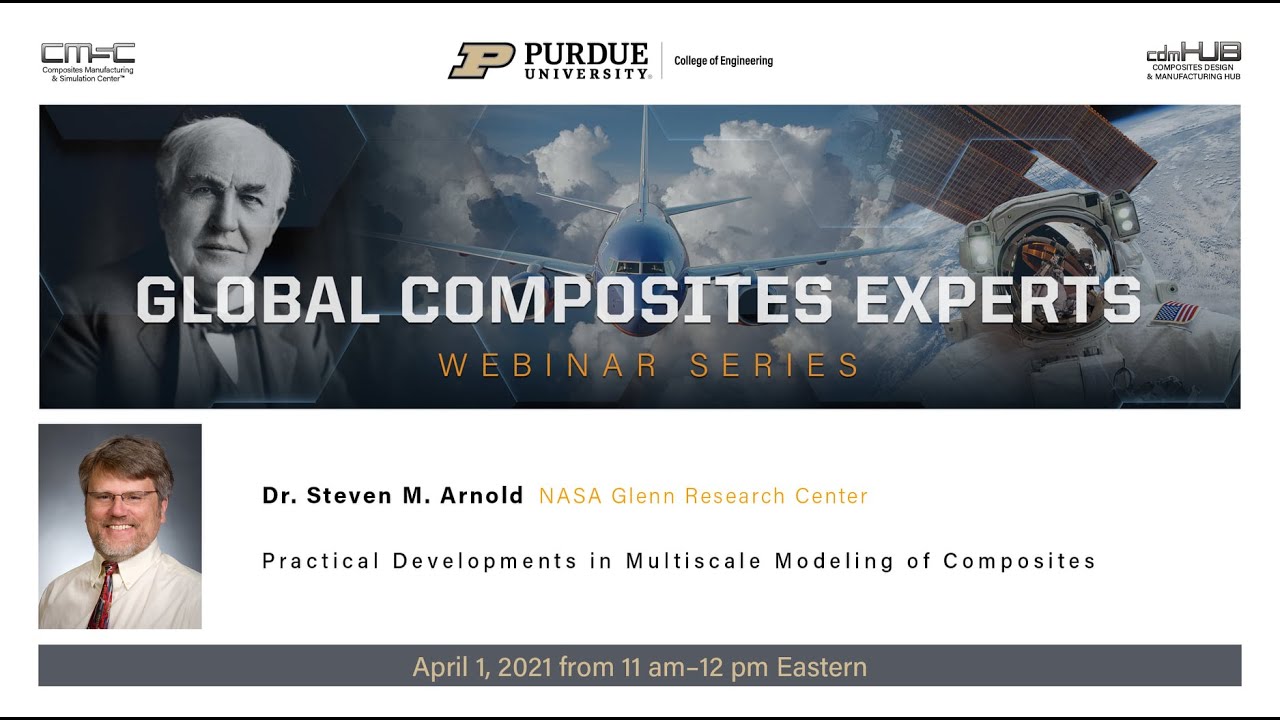
Expert Lecture Spotlight | Steven Arnold
Practical Developments in Multiscale Modeling of Composites
Multiscale modeling plays a pivotal role in the design and certification of advanced composite materials—enabling virtual experimentation, reducing cost, and accelerating innovation. But achieving the right balance between model fidelity and computational tractability remains a central challenge.
In this lecture, Steven Arnold presents a practical overview of NASA Glenn’s multiscale modeling toolset, rooted in the method of cells micromechanics framework. He explores how different modeling strategies address the fidelity-speed tradeoff:
 Hierarchical multiscale models: Leverage precomputed homogenized properties for fast simulations—but may sacrifice fidelity.
Concurrent multiscale models: Capture microscale behavior at every integration point—offering high fidelity but demanding computational resources.
 Enter machine learning surrogates:
Arnold highlights how ML-based surrogate models can replicate physics-based simulations with orders-of-magnitude faster performance, making high-fidelity modeling more practical for real-world applications.
The talk concludes with recent developments at NASA focused on accurate prediction of the thermomechanical behavior of composites, demonstrating how validated models—whether data-driven or physics-based—can power a new era of digital certification and rapid design iteration.
 Watch the full talk on the cdmHUB YouTube channel as part of the Global Composites Expert Webinar Series.