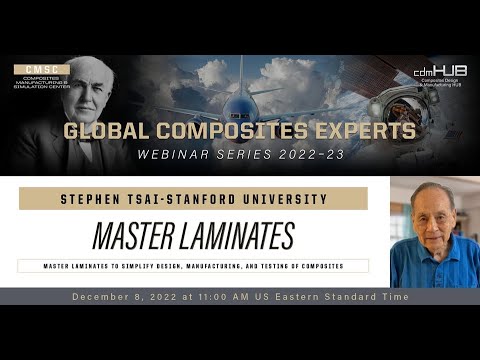
Expert Lecture Spotlight | Prof. Stephen W. Tsai Master Laminates to Simplify Design, Manufacturing, and Testing of Composites
Composite design has long been seen as more complex than working with metals—but what if that complexity is largely self-inflicted?
In this transformative lecture, Prof. Stephen W. Tsai introduces the concept of Master Laminates, offering a unified and radically simplified approach to composite stiffness and strength analysis—making composites as straightforward as metals.
Master Stiffness Envelope
Laminate stiffness is reduced to two intuitive components:
Trace – total stiffness capacity
Partitioning of trace – laminate-specific behavior
Requires only one uniaxial test
Eliminates the need for complex and unreliable shear testing
Master Failure Envelope
Strength is also captured in two parts:
Size – related to material strength
Shape – related to loading condition
Uniaxial tensile and compressive tests are sufficient for characterizing strength—even for flawed or holed coupons
This methodology not only simplifies design allowable generation, but also unlocks a common-sense path to composite standardization—positioning composites to compete head-to-head with metals in terms of ease of use, testing, and certification.
Prof. Tsai @stevewtsai has been advocating double-double laminates in recent years. Very recently, he gave the Lagace Lecture on it and a couple of years ago he also gave a lecture in the Global Composites Experts Webinar Series. However, not many people have a good understanding of double-double laminates. Recently, Prof. @FDanzi, in his introduction, mentioned that he is doing research related to double-double laminates. It believe it is a good chance for us to have a deep discussion about it for better understanding. Below is his opinions about DD laminates. Feel free to add your opinions.
@FDanzi great points. It seems that many advantages are offered through the fact DD laminates are close to be homogeneous. However, for a laminate to be homogenizable, there are two constraints:
B=0
D=h^2/12 A
Generally speaking, if the laminate subgroup repeats many times (i.e., the lamina is thin), these two conditions will be satisfied, not only DD laminates. Please refer to the following paper (Example section 4.1) on showing B is proportional to 1/N with N as the number of lamina group repeats.
Lee, C.-Y. and Yu, W.: “Homogenization and Dimensional Reduction of Composite Plates with In-Plane Heterogeneity,” International Journal of Solids and Structures, vol. 48, no. 10, 2011, pp. 1474-1484.
Several questions on the topic, and no I haven’t had a chance to dive into Double-Double composites yet:
What are the origins of the differences in test results between the NASA testing of double-double laminates that did not show compression-after-impact (CAI) toughness impacts of thin plies, and the previous literature that does for traditional laminates?
How do the available weight savings from double-double compare to those available from NTL as a whole, or to techniques that allow fiber direction to change within a ply? Simplifying design can be valuable, but some industries will accept harder design if it comes with a performance enhancement.
Parts tend to have different mechanical requirements at different locations - filled hole tension might be important near a bolted interface but may not be critical over the acreage of the part. Do these requirements lead to different angles for the laminate that should be used to comprise the part, and is the design methodology that accounts for this actually any simpler than the current design method?
Picture a C-spar that is not uniform width. For simplicity: one of its radii is aligned along the 0-direction and its other radius is curved. The fiber angles on the web are going to be the same as the fiber angles on one flange, but the fiber angles on the other flange are going to be different. How does this impact double-double composites and the simplified design method?
It’s a great topic, I look forward to learning more, and I am awed that this senior researcher is still presenting work that puts our past research to shame!
@DanHumfeld thanks a lot for your insightful comments! I am bring this to the attention of a few folks who I know are working on DD laminates @stevewtsai@FDanzi@naresh for their comments.
 Expert Lecture Spotlight | Prof. Stephen W. Tsai
 Master Stiffness Envelope
 Plus, a free downloadable book on the Double-Double design approach is available at:
 compositesdesign.stanford.edu
 Watch the full lecture now on cdmHUB’s YouTube channel as part of the Global Composites Expert Webinar Series.