VAPAS shows excellent accuracy for interior solutions like cylindrical bending, but are its interlaminar stress predictions near free edges reliable? Some argue that VAPAS is fundamentally an “interior solution” theory, with limitations in boundary regions.
MSG addresses this through a “beam-like + 2D SG” framework, but I’m not sure about its limitations. Does it work for thick plates or square plates?
Has VAPAS been successfully applied to free-edge problems? Is MSG considered the mainstream approach for this? Any insights appreciated.
No, VAPAS cannot handle free-edge stresses accurately, it is for interior solutions only. We applied VABS for free-edge stress analysis for a few cases, and good results are obtained for a strip-like of composites, thus still qualifies to model it as a beam (see two references below). However, we never applied it to a square plate. If you are interested, it will be an interesting topic to pursuit.
Peng, B.; A; Goodsell, J.; Pipes, R. B. and Yu, W.: “Generalized Free-Edge Stress Analysis Using Mechanics of Structure Genome,” Journal of Applied Mechanics, vol. 83 (10), 2016, 101013.
Goodsell, J.; Peng, B.; Pipes, R. B.; and Yu, W.: “Interlaminar Stresses in Composite Laminates Subjected to Twisting Deformation,” Journal of Applied Mechanics, vol. 84 (10), 2017, 104503.
Thank you for your answer and the two recommended references. I basically understand the logic of VABS in the case of narrow strips (1D beams).
For a square plate, if we want to extend the MSG application, the core difficulty is whether we should directly develop a true two‑dimensional “plate genome” (considering the coupling of both in‑plane directions) or only divide it into parallel micro‑strips and then coordinate the interfaces? If there are any follow‑up ideas or unpublished attempts, I would very much look forward to learning from you.
Since free edge stress is localized in the boundary. It is possible to solve the problem as micro-strips with a free-edge and a loaded surface from the interior solution (recovered from VAPAS). I have almost daily communications with Dr. Pipes, the person who discovered the free-edge stress phenomena.
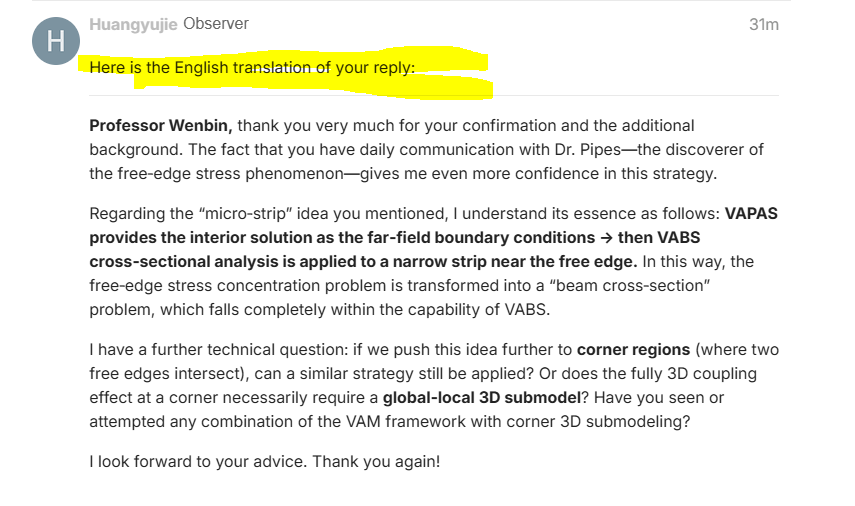
Professor Wenbin, thank you very much for your confirmation and the additional background. The fact that you have daily communication with Dr. Pipes—the discoverer of the free‑edge stress phenomenon—gives me even more confidence in this strategy.
Regarding the “micro‑strip” idea you mentioned, I understand its essence as follows: VAPAS provides the interior solution as the far‑field boundary conditions → then VABS cross‑sectional analysis is applied to a narrow strip near the free edge. In this way, the free‑edge stress concentration problem is transformed into a “beam cross‑section” problem, which falls completely within the capability of VABS.
I have a further technical question: if we push this idea further to corner regions (where two free edges intersect), can a similar strategy still be applied? Or does the fully 3D coupling effect at a corner necessarily require a global‑local 3D submodel? Have you seen or attempted any combination of the VAM framework with corner 3D submodeling?
The strategy is not what I get from Dr. Pipes and will not work for the corner. If you attend ASC this year, you will get a change to meet Dr. Pipes and he will give a plenary talk on free edge. ASC Madison 2026. We will have all his knowledge related to free-edge stress available via CompositesAI very soon.
Professor Wenbin, I apologize for the misunderstanding. To clarify: the ideas and questions are exactly what I wanted to ask—I just have limited English proficiency, so I asked an AI to polish and translate my Chinese into English before posting. I did not simply copy AI-generated content.
Regarding your correction, I now understand: the micro‑strip/VABS strategy works for straight free edges but cannot be extended to corners.
Thank you for mentioning ASC Madison 2026 and the CompositesAI platform—I will keep an eye on them and hope to learn more in person if possible. Thank you for your guidance!
I will look into further relevant literature, attempt to understand the methodology, and possibly try some implementation myself. The only pity is that I currently do not have access to a software license for VABS or SwiftComp.