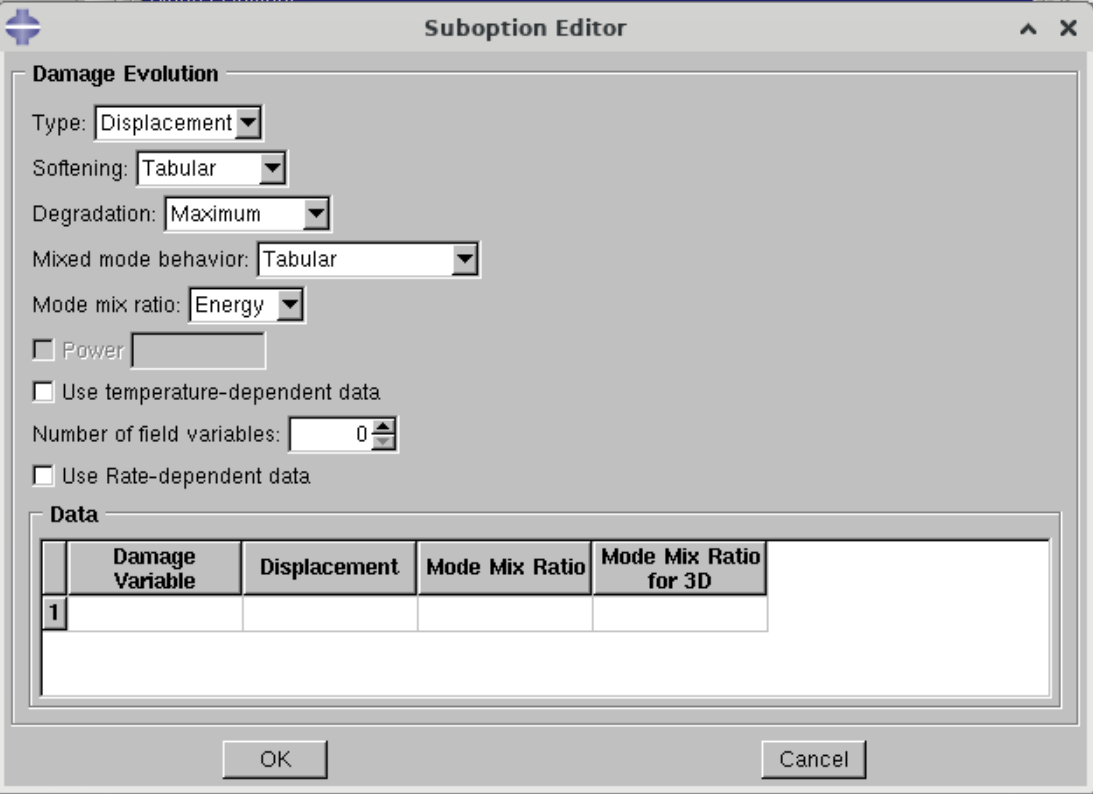
@Wenbin For defining different softening shapes other than the available bilinear or exponential softening behaviors, Abaqus allows the functionality to provide damage variable data as a function of relative effective separation in a tabular form. For the mode-independent case, defining and generating the desired tabular data is somewhat straightforward and has several good sources of instructions. However, for the mixed-mode case, Abaqus expects us to provide the damage variable data as a function of relative effective separation, “Mode Mix Ratio”, and “Mode Mix Ratio for 3D”, as shown in the first screenshot. The Abaqus documentation provides the details on how to define the tabular data for the mixed-mode cases when using energy-type damage evolution (limited to linear or exponential softening), as shown in the second screenshot. However, I have not found any source of reference on how to define and generate the damage variable data for displacement-type damage evolution, considering the mixed-mode case. Would anyone please help me in this regard or share their experience and expertise?
@kmao24 @BoPeng @tao364744553 can any of your Abaqus experts help answer the question.
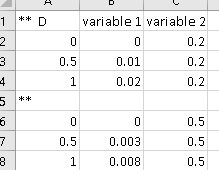
It seems that you already understand how to define the damage variable (D) in terms of a single variable displacement. If it has an additional variable, then you need to repeat the single variable table. For example, the following illustrate the format for D depends on 2 variable. In your case, it depends on 3 variable, then you follow the same logic to define the table.
kmao24
Thank you, Dr. @kmao24 for the reply. What I understand from the single variable case is that we are defining the TS law for the mode-independent case, where the same TS law applies in any directions (normal, and two shear directions). Since Abaqus does not allow you to define different parameters (e.g., fracture energy) for individual directions except cohesive strength (I am not sure whether different cohesive strengths play any role in this case), my understanding is that this mode-independent definition is appropriate for pure-mode simulations (e.g., pure normal (mode-I) simulations like DCB test; pure shear (mode-II) simulations like ENF test). Abaqus defines two independent parameters for mixed-mode ratio as 1) m_2+m_3=(G_s+G_t)/G_T, which denotes the ‘Mode Mix Ratio’ column; 2) m_3/(m_2+m_3)=G_t/G_T, which denotes the ‘Mode Mix Ratio for 3D’ column as per Abaqus documentation. Based on these definitions, the ‘Mode Mix Ratio’ is either zero (mode-I) or 1 (mode-II) for the mode-independent case. This is why you can define a single TS law considering any softening shape (T_d(∆_m)) for your desired mode and determine the damage variable for the softening part with ‘D=1-T_d(∆_m)/(K_p*∆_m)’. In such a definition, your effective separation is equal to the pure-mode separation ∆_n or ∆_s, similarly, the effective critical separation δ_m^c and final separation δ_m^f follow the pure mode critical and final separation. Ultimately, you can define the damage variable only as a function of the relative effective separation (∆_m-δ_m^c). I have tested Abaqus results using its linear and exponential softening laws against my tabular damage data, and the results match exactly. However, in the most general mixed-mode situation, you have different parameters (e.g., fracture energy) and softening laws in different directions, resulting in having different TS laws in normal and two shear directions. Since the damage variable, D, is a single parameter with only one column in the table, how do you calculate it since you no longer have a single T_d(∆_m) to put into ‘D=1-T_d(∆_m)/(K_p*∆_m)’? Additionally, how do you calculate the effective critical separation δ_m^c and final separation δ_m^f as a function of ‘Mode Mix Ratio’ (m_2+m_3=(G_s+G_t)/G_T) and ‘Mode Mix Ratio for 3D’ (m_3/(m_2+m_3)=G_t/G_T)? Ultimately, how do we generate the tabular damage variable data as a function of relative effective separation (∆_m-δ_m^c), ‘Mode Mix Ratio’, and ‘Mode Mix Ratio for 3D’?
hi, Rumi,
I think your understanding is mostly correct. In terms of your question of how to calculate D vs differnt mode mixture? In theory, this is the INPUT to Abaqus, which means that they are either obtained from real test data or from your theoretical derivation. If your cohesive is mode-dependent, then you need to do traction-separation tests (or theoretical derivations) under different mode mixture. Once you have the test data from multiple mode cases (or your derivation), you can organize them into Abaqus format I mentioned before. The damage variable, D, definition is simple, which is the discount ratio from the undamaged response of the traction.
Abaqus energy form of the damage model also has the mode mixture, although the mode mixture is reflected in the formula.
kmao24
Yes, Dr. @kmao24
I am exactly looking for the theoretical derivation of the damage variable in the mixed-mode case. I looked into the original papers that Abqus followed to implement the cohesive TS law. However, those papers assumed a linear softening case, and the formulation they provide only works for linear softening. Though Abaqus also provides the facility to use the exponential softening law, it mentions the following definition of the damage variable for exponential softening:

I know they calculate the effective separation as the vectorial expression of the directional separations, as described: ∆_m=sqrt(∆_n^2+∆_s^2+∆_t^2)
Do you know how they calculate the effective traction, T_eff? I tried a theoretical derivation assuming T_eff as the vectorial expression of the directional traction components as: T_eff(∆_m)=sqrt(T_n(∆_n)^2+T_s(∆_s)^2+T_t(∆_t)^2)
However, the results based on my tabular damage data do not match those from Abaqus’ default results, even for the linear case. The documentation does not provide any information related to the T_eff definition, and neither do the papers mention T_eff. That’s why I am stuck here and have no clue what Abaqus expects for the accurate theoretical derivation of the damage variable. It would be great if you could suggest anything in this regard.
Hi, Rumi,
First I have to say that I do not know the formula, since our developers regard a lot of things as confidential. So I work on the same materials as you have.
For this particular issue, I feel that the Teff is energy congugate to the effective separation (which is defined in the document). In other words, the numerator of the integrand, Teff*d_delta, represents the incremental damage energy in an increment. Its ratio with the total damage energy, Tc-T0, reflects the increment damage variable D. So, if you have a numerical test in which the mode mixture is fixed, you can calculate Teff x d_delta based on individula traction and separation componnets to obtain the damage energy increment, and then compare it with D from Abaqus.
kmao24
Thank you, Dr. @kmao24 I will try to dig into more details on this.