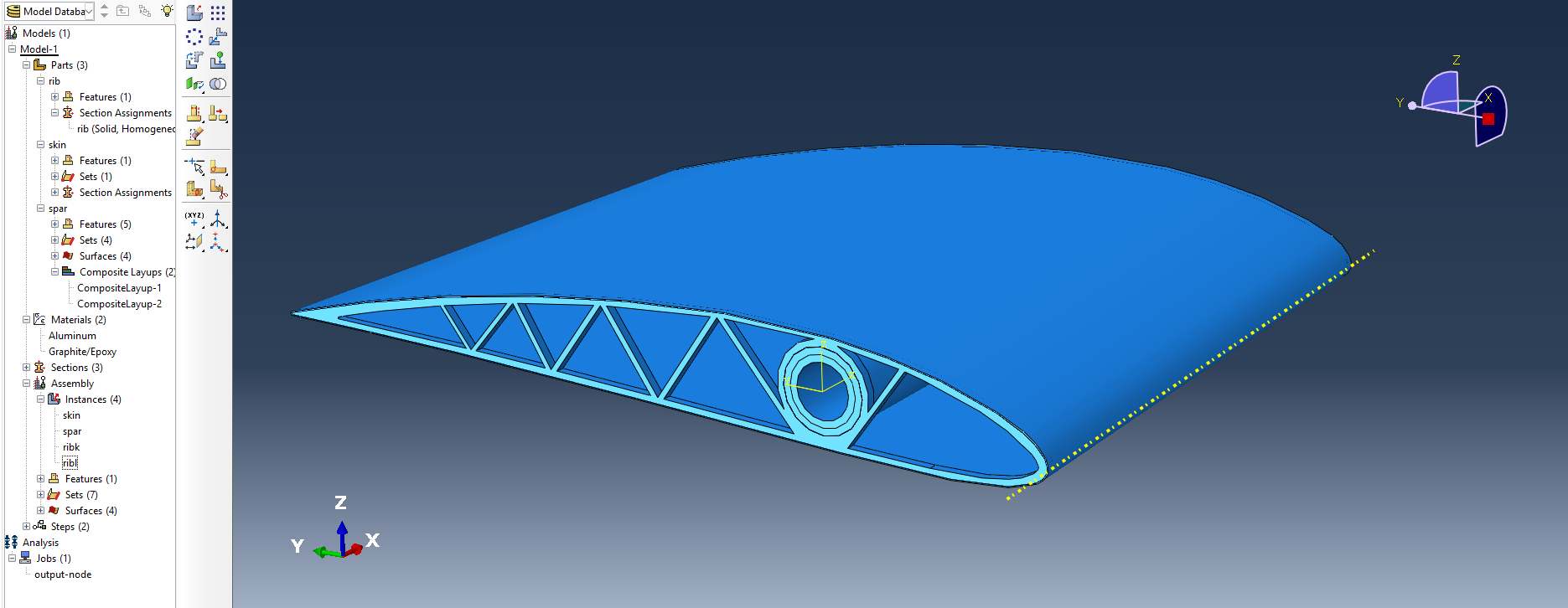
The 3D SG below is made of skin, spar, and two ribs (one at the front and another one at the back). For an SG like this, I wrote the inp file and used sgio to write the sc file for SwiftComp, but I think tie constraints are ignored because I don’t see it defined in sc file. Is there a way to model a 3D SG with separate parts using constraints to tie them together? @su.tian.22 @Haodong @bagla0
2 Likes
@SichenLiu I am not sure why are you using tie constraints for homogenization?
SwiftComp has capability to take care of both periodic and aperiodic boundaries.
2 Likes
Because the 3D SG for the wing is complicated so it is hard to create it as one single part. Creating separate parts allows us to create mesh individually which helps create periodic BCs. In this case, the mesh of the rib at the front can just be copied to the one at the back.
The reason I avoid aperiodic nodes is because I do not know how much aperiodic nodes will influence the results, and I believe prof @Wenbin mentioned not having periodic nodes will have some impact on the results. And the benchmark problem is supposed to be periodic not aperiodic.
1 Like
I am not sure about using tie constraints for using it in SwiftComp.
Are you making a straight periodic 3D SG? If yes, the easiest way is to use gmsh (as I discussed the process with you earlier)
Are you creating the airfoil cross-section manually in Abaqus using coordinates data? If yes, created geometry ends can be partitioned, to make mesh periodic at ends. (Conventional way to mesh complex geometry)
1 Like
The structure should be periodic so ideally we should be using periodic BC. I am not very familiar with using gmsh to generate a strictly periodic mesh so I may need to refer to some tutorials online.
It appears that the geometry I got is imported using STEP so I do not have access to the airfoil data. This geometry is given in the cae file that another person shared with me.
1 Like
@SichenLiu, the step geometry can be imported in Abaqus and mesh periodically using partitioning and mesh size selection. this mean, do not mesh entire 3D SG in a single command, but mesh part by part.
1 Like
We don’t have tie constraints in SwiftComp. Periodic nodes are automatically eliminated.
1 Like
@SichenLiu as far as I know, swiftcomp does not have contact capability. You may consider to merge the mesh at the boundary. That would connect nodes together.
Abaqus does not support generating nodes with position constraints accurate enough to meet the precision requirements of SwiftComp.
I recommend using Ansys or HyperMesh, both of which have been verified to work. In my case, I used an older Ansys benchmark and controlled node positions precisely through APDL scripting. While the newer versions of Ansys are more user-friendly, I haven’t personally tested them. HyperMesh is also a viable option and may be more convenient for modeling blade structures compared to the Ansys benchmark workflow.
2 Likes
@BoPeng thanks a lot for your insights. @SichenLiu
@SichenLiu , you can create periodic nodes using a copy mesh command in Ansys if you need that. Please make sure that your model needs to be similar in the opposite sides to create a period node and use copy mesh command in Ansys .
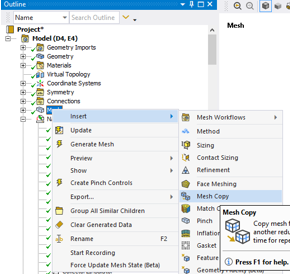
In reality I had difficulty implementing this as I indeed used Mesh Copy but meshing keeps failing despite the geometry being perfectly symmetric (I checked the edges, surfaces, which should match exactly on both surfaces).
Please make sure that you used aglue,all, vglue,all to avoid overlapping area and volume. That may affect not to generate the nodes on the other sides. Before using mesh copy, please make that all pieces of areas in opposites sides have the same area size.
If mesh copy does not work for you for any reason, please try to use the following:
type 1
esize,0.275
! First mesh the area
asel,s,loc,x,1 ! example
amesh,all
alls
asel,s,loc,x,1 ! copy the mesh on the area ( from already meshed area)
agen,2,all,-2 ! on opposite sides ! pastes the mesh on the opposite sides
alls.
Hope this helps.
1 Like
@Hamsasew thanks for your kind suggestion. I’ve studied how to make periodic nodes but for this problem it seems it is very difficult to do on ansys, because I have very little control over the geometry as it was given to me as a cae file from another researcher. I’ve attempted a couple of fixes on Ansys but it seems Ansys still has trouble making the mesh exactly the same on periodic boundaries. It seems that the area around trailing edge is very tricky, and I suspect that the trailing edge may not be perfectly identical despite my attempts to fix it.
Since I am unfamiliar with the advanced settings for Ansys, I can’t spend more than 2-3 weeks attempting to fix it on Ansys. So I decided to use copy mesh pattern on Abaqus and write scripts to assist generating periodic mesh on periodic boundaries, which turned out to be working for me.
Again thanks for insights on generating periodic mesh on Ansys. It is one of the most difficult parts in analyses with SGs.