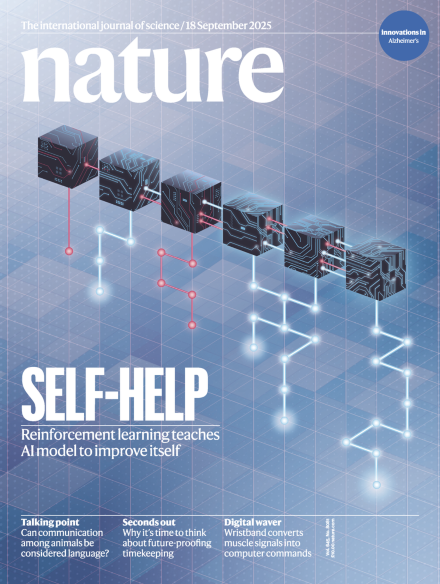
The latest issue of Nature (Volume 645, Issue 8081, 18 September 2025) features DeepSeek-R1, the first major open-weight large language model (LLM) to be published after independent peer review. This marks a milestone in transparency for AI research.
The Nature cover highlights how LLMs improve when trained to reason step by step, similar to human problem-solving. Traditionally, this required costly human-labeled reasoning traces. DeepSeek-R1 instead learns reasoning via reinforcement learning (RL): it receives rewards for correct answers and penalties for wrong ones, discovering that verification and self-reflection improve accuracy. As a result, the model achieved strong performance in mathematics, coding, and graduate-level STEM tasks.
The accompanying Nature editorial emphasizes the importance of peer review for LLMs: it improves clarity, ensures safety evaluations, and reduces hype in an industry where claims are often unverifiable. Reviewers pushed DeepSeek to include more detail on data contamination mitigation and safety testing, leading to a stronger, more transparent publication.
The research article itself describes the RL framework (GRPO), the emergence of reflective behaviors (e.g., “wait… let’s reconsider”), and how the refined DeepSeek-R1 balances reasoning, readability, and safety. While limitations remain — such as token efficiency, prompt sensitivity, and limited multilingual robustness — the work demonstrates RL as a scalable path to incentivizing reasoning in LLMs without heavy human annotation.
For readers who can read Chinese, you may refer to this Zhihu post for a more detailed review: Zhihu Review of DeepSeek-R1.
References
-
Nature Issue: Vol. 645, Issue 8081 (18 Sept 2025)
-
Research Article: “DeepSeek-R1 incentivizes reasoning in LLMs through reinforcement learning”
-
Editorial: “Bring us your LLMs”