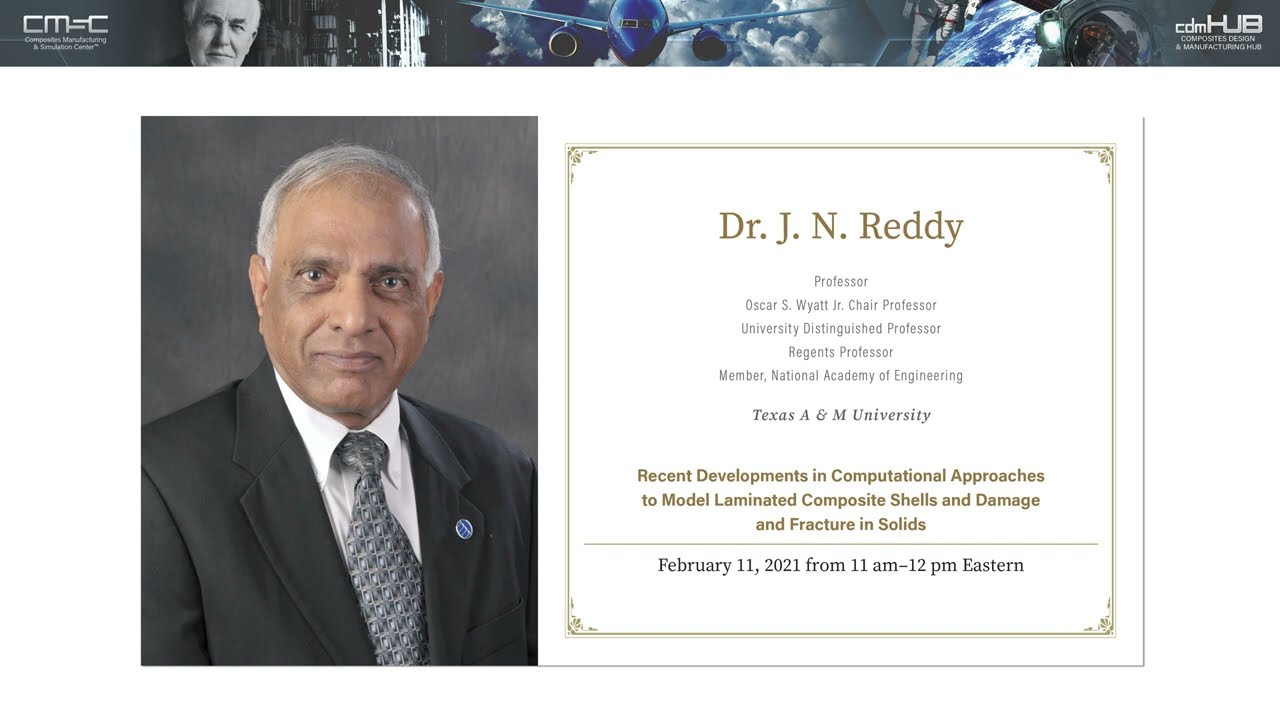
Expert Lecture Spotlight | Prof. J.N. Reddy
Computational Approaches to Model Laminated Composite Shells and Damage & Fracture
In this insightful lecture, Prof. J.N. Reddy explores two critical and forward-looking topics in computational mechanics for composites:
 Locking-Free Shell Finite Elements for Laminated Composites
Developed from seven- and twelve-parameter shell theories, these elements allow nonlinear analysis of isotropic and laminated shells, including thickness stretch and full 3D constitutive behavior. Unlike traditional methods, no ad-hoc fixes like reduced integration or artificial stabilization are needed—eliminating thickness, shear, and membrane locking with a truly robust formulation.
 GraFEA: A Graph-Based Finite Element Framework for Fracture
GraFEA represents a paradigm shift in modeling damage and fracture:
 It focuses on nodes and the links between them
Fracture is modeled via breakage of edges—not element discontinuities
Uses weakest-link statistics and a strain-based criterion for failure
Highly flexible—other failure criteria can be incorporated
Numerical examples illustrate the power and generality of this method, which brings fresh perspective to fracture simulation in solids and composites.
This lecture offers both theoretical depth and computational innovation—redefining how we approach nonlinear shell behavior and damage evolution.
 Now available on the cdmHUB YouTube channel as part of the Global Composites Expert Webinar Series.