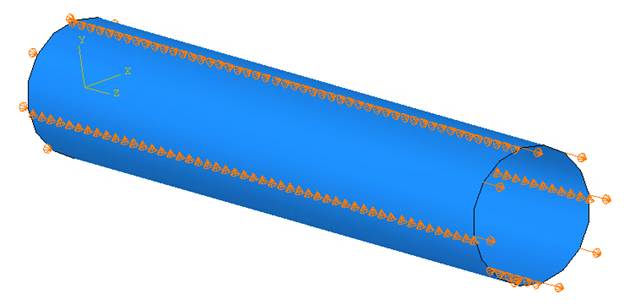
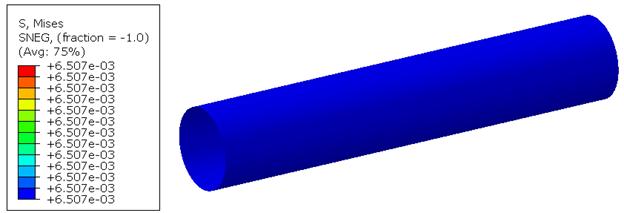
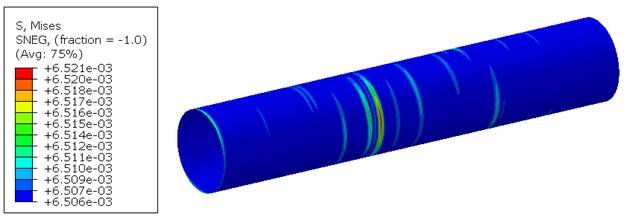
The response is expected to be purely membrane, with no bending.
The prescribed displacement0.0315 mm is applied using an amplitude function:
1. From 0 s to 200 s, the displacement increases rapidly.
2. From 200 s to 1000 s, the displacement is held constant.
*Amplitude, name=Amp_paper, time=TOTAL TIME
1., 0.5, 10., 0.658333333, 22., 0.725, 44., 0.791666667
74., 0.866666667, 106., 0.933333333, 148., 0.975, 200., 1.
1000., 1.
Unexpectedly, the analysis diverges at approximately 720 s.
There is no additional loading applied after 200 s, the displacement increment is 0.
The model remains stable with perfectly uniform stress distribution until around 586 s.
Then, a localized stress concentration begins to develop spontaneously; eventually the solution diverges at about 720 s.
Has anyone encountered similar behavior with S4R shell elements or hyperelastic materials?
Any suggestions on possible causes would be greatly appreciated.
Hi, Denism, Based on your description, the model should not have a convergence issue, unless something more in your model. I created a model in accordance with your descritions, and it converges quickly. Please compare my model with yours to see what kind of differences are.
Hi, Denism, One more note: my previous response was based on relatively coarse mesh. I also tested another case using your mesh size of 180e-6 mm, and the model also converges quickly.
Yes, with automatic incrementation the model converges without any issues. The problem arises when you force it to make smaller increment. Unfortunately, I cannot attach my .inp because I am a new user.
If you could kindly share your .inp with fine mesh, I will be able to modify the Step parameters to show the issue and post back the modified lines.
Hi, Denism, The refined mesh model attached. Note that all models use a perfectly generated cylinder geometry. If the gemetry is not quite perfect, it could also cause the stability issue since the shell is very thin which can experience numerical or physical instability. if so, please test a case with an increased shell thickness. Rehard, kmao24
then model will diverge around 870 s. The modification only forces Abaqus to make increments no longer than 10 s and write results approximately with 10 s time interval.
I tried with twice thickness, no effect, model still diverge at the same 870 s.
HI, Denism, After changing the refined model to your conditions, I’m able to reproduce the convergence issue. From my check, the convergence is due to the two possible instabilites:
1- the Yeoh material used can be instable at about 60% nominal strain (this can be see in the .dat file when you set *preprint, model=yes. Note that I’m using abaqus input, not the 3DX platform). Your tube is stretched to a similar range.
2- the thin tube itself can experience instability.
Currently, the instability seems due to the numerical reasons, since your loading is completed at time=200. Between 200 to 1000, the load is constant, and your analysis is the static analysis. So, the solutions are supposed to be the same between 200 and 1000.
Do you have any specific reasons for this? Due to the instabilities aforementioned, the numerical issues occur.
For the coarse mesh model, it seems that there is no such issue. So if you really need to have “do nothing” period between 200 and 1000, either coarsening the mesh or increasing the increment size to make it go through.
This model is a precursor to a more complex model subjected to a stress relaxation test; hence the “do nothing” stage.
I was debugging the more complex model by simplifying it as much as possible, and, to my surprise, I found that it still diverges even without viscoelasticity and with a perfectly structured mesh.
My initial suspicion was that the issue might be related to pure membrane loading of the shell elements, or perhaps to the rotational degrees of freedom, which remain free in this setup.
There is also a possibility that solver introduces some perturbation for the initial guess of the next step. This too can trigger divergence if model is prone to instability.
For your rea problem, we can use the experiences found in this “do nothing” run like changing mesh size or changing increment size. Your current exploration into this “do nothing” stage indicates that the issues are from the numerical aspects like the material instabilities or the structure instabilities (like membrane stress state). The solution process always involves some noises (errors). When a structure is stable, the noises will die down over iterations. On the opposite, when it is instable, even small noises will grow quickly to be out of control. Sometimes, making some small changes in the model can get around these local instabilities.
For your real relaxation problems, suggest first try to use relatively coarse mesh to find a solution, and next do the refinements. By estabilishing a solution, even at a low resolution, it can be much easier later to debug a problem when dealing with a more refined or more complex problem.